

22-01_moc10-day26--Remembrance-or-Tribute-Layout
- Description
- January 26: Remembrance or Tribute Layout
https://the-lilypad.com/forum/threads/january-26-remembrance-or-tribute-layout.81812/
Rachel Jefferies
Carefully curated - patina
https://the-lilypad.com/store/Carefully-Curated-Patina-Collage-Bits-And-Bobs.html
oh yes you can
https://the-lilypad.com/store/Oh-Yes-You-Can-Mixed-Media-Kit.html
Messy Threads4
https://the-lilypad.com/store/Messy-Threads-4.html
Falalala
https://the-lilypad.com/store/Fa-La-La-La-La-Elements.html
give yourself permission
https://the-lilypad.com/store/Give-Yourself-Permission-The-Complete-Mixed-Media-Collection.html
Riding the rails
https://the-lilypad.com/store/Riding-The-Rails-Mixed-Media-Artistry.html
Valorie Wibbens
AlfaBeads
https://the-lilypad.com/store/Alpha-Beads.html
---
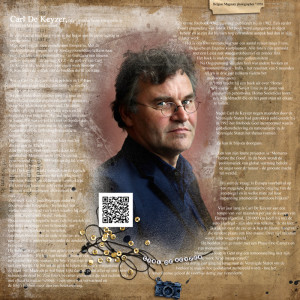
A tribute to one of our best Belgian photographers - Carl De Keyzer
Carl De Keyzer, one of our best photographers in Belgium and Magnum photographer.
I've been following Carl for a long time - from the early eighties in the last century (that sounds weird)
My husband was taking evening photography classes at the time. Every Sunday morning we went with fellow students to some photo exhibition - a new gallery was opened in Ghent - the gallery XYZ – the gallery of Carl De Keyzer . First He exhibited his own work.
I was impressed by the images I saw then.
Who is Carl De Keyzer - he was born in 1958 and during his youth he had three hobbies: football, music and photography.
After graduating from high school, he went to university to study veterinary medicine - but it didn't interest him. The first grades of his exams were disappointing and he called it quits. He was more interested in art. He was living in Ghent and without his parents knowing, he started at the Academy to study Photography.
He graduated with flying colors - later he was a teacher at the Academy.
His photographic work was noticed by the agency Magnum and in 1992 he was associated to become a full member for life in 1994.
Carl De Keyzer uses the typical photographic techniques that also characterized Magnum founder Henri Cartier Bresson; He chooses his frame and picks the right moment. He is not interested in staging.
His work can be classified under documentary photography - he tells a story on the basis of photos in which he puts his own stamp on the story. Documentary photography is ideal for holding a mirror up to people, telling (background) stories, discussing world problems and drawing attention to controversial subjects.
He has his own style - a special way of shooting - always different. He can turn banal situations into unforgettable photos. The photos are inimitable - not even a little.
At first glance, his photos seem a bit messy: they are full. But if you take a closer look, you will see that everything is subtly ordered.
His photos contain elements that are not directly related - are sometimes a bit confusing - the photos have more than one layer of meaning.
He published his first photo book 'Oogspanning' in 1982. A rather loose collection of photos. The book was self-published and you can see that he had a different approach then than in his later work.
It is a photo collection of a number of trips along French, Belgian and English coastal towns. All photos were taken with a Leica with standard lens and no flash. The book is now a collector's item.
Oogspanning was followed by many other books and exhibitions - India – the result of 5 months of travel in three years (each time during the monsoon season). In 1989 he published a book about Homo Sovieticus - the Soviet Union in the years of glasnost and perestroika. Homo Societicus shows a world power that is about to fall apart.
After Carl de Keyzer had traveled through the United States for nine months, he published the photo book God incorporated in 1992, in which religious experience and nationalism in the United States form the theme.
So I can keep going.
One of his later projects is 'Moments before the flood'. This book examines the issue of global warming - the fear of nature - the greatest power in the world.
He asks: is Europe prepared for a possible dramatic rise in sea levels and to what extent will its effort ultimately prove futile?
For four years Carl De Keyzer traveled the coasts of Europe at a pace of four months a year. He covered 120,000 km by car - his idea was always: “I'm standing here, I look out over the sea and I am the last photographer to take a picture in this place. Everything will be washed away in five minutes.”
The images were shot with a Phase One Camera and are monumental.
There is currently an exhibition in Ghent with his most recent work ... "God incorporated2"
After thirty years, he went back to the United States to create the images of how religion is lived today - how American faith has changed over the past thirty years.
710 words