Day 11 - MOC 2021 - Tell Me a Story (731 words)
Credits:
Digital Scrapbook Template - Artsy Journal 1 | Scrapping with Liz (the-lilypad.com)
Kohi Kit by The Lilypad designer Lynn Grieveson (the-lilypad.com)
key to my heart (kit) by sahlin studio (the-lilypad.com)
Lilypad Collab - Roots:
Digital Scrapbooking Kits | Scrapbook Kits – The Lilypad (the-lilypad.com)
Forever Joy - 2020 kit (now retired) - magnifying glass
Journaling reads:
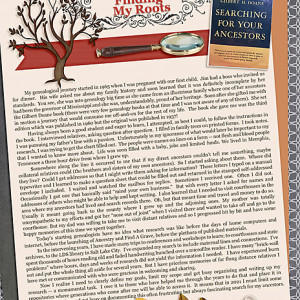
My genealogical journey started in 1965 when I was pregnant with our first child. Jim had a boss who invited us for dinner. His wife asked me about my family history and soon learned that it was definitely incomplete by her standards. You see, she was into genealogy big time as she came from an illustrious family where one of her ancestors had been the governor of Mississippi and she was, understandably, proud of her heritage. Soon after she gifted me with the Gilbert Doane book (there were very few genealogy books at that time and I was not aware of any of them). She set in motion a journey that would consume me off-and-on for the rest of my life. The book she gave me was the third edition which was published in 1960 but the original was published in 1937!
Having always been a good student and eager to learn, I attempted, as best I could, to follow the instructions in the book. I interviewed relatives, asking question after question. I filled in family trees on printed forms. I took notes. I was pursuing my father’s line with a passion. Unfortunately in my ignorance of what would later be important to my research, I was trying to get the chart filled out. The people were names on lines on a form -- not flesh and blood people that I wanted to know more about. Life was soon filled with a baby, jobs and limited funds. We lived in Memphis, Tennessee a three hour drive from where I grew up.
Somewhere along the line it occurred to me that if my direct ancestors couldn’t tell me something, maybe collateral relatives could (the brothers and sisters of my own ancestors). So I started asking about them. Where did they live? Could I get addresses so that I might write them asking for information? Those letters I typed on a manual typewriter and I learned to make a question sheet that could be filled out and returned in the stamped self-addressed envelope I included. I waited and watched the mailbox for replies. Sometimes I received one. Often I did not. Occasionally I got one that basically said “mind your own business.” But with every letter I asked for names and addresses of others who might be able to help and kept writing. I also learned that I needed to visit courthouses in the area where my ancestors had lived and search records there. Oh, but that meant time and travel and money to do so. Usually it meant going back to the county where I grew up and the adjoining ones. My mother was totally unsympathetic to my efforts and got her “nose out of joint” when I visited there and wanted to take off and go to the courthouse. But my dad was willing to take me to visit distant relatives and so I progressed bit by bit and have some happy memories of this time we spent together.
Today’s starting genealogists have no idea what research was like before the days of home computers and internet, before the launching of Ancestry and Find A Grave, before the plethora of published materials.
In the intervening years, I have made many trips to conferences and workshops to learn; to courthouses and state archives, to the LDS library in Salt Lake City. I’ve expanded my search to include maternal lines and connections. I’ve spent thousands of hours reading old and faded handwriting hunched over a microfilm reader. I have many “brick-wall problems” where hours, days and weeks of research did not yield the information I needed. I have experienced burn out and put the whole thing all aside for several years. But I have priceless memories of far flung distance relatives I have met or communicated with who were gracious in welcoming and sharing.
Now I realize I need to clearly define my goals, limit my scope and get busy organizing and writing up my research -- a monumental task. I owe it to those who have helped me through the years to do that and place it in repositories where generations who come after me will be able to access it. It means that in 2021 I must limit some other things I enjoy and get busy on documenting this often frustrating but always fascinating search for my ancestors.