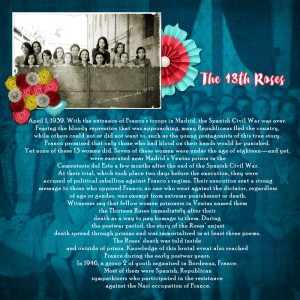
STORY: April 1, 1939. With the entrance of Franco’s troops in Madrid, the Spanish Civil War was over.
Fearing the bloody repression that was approaching, many Republicans fled the country,
while others could not or did not want to, such as the young protagonists of this true story.
Franco promised that only those who had blood on their hands would be punished.
Yet none of these 13 women did. Seven of these women were under the age of eighteen—and yet,
were executed near Madrid’s Ventas prison in the
Cementerio del Este a few months after the end of the Spanish Civil War.
At their trial, which took place two days before the execution, they were
accused of political rebellion against Franco’s regime. Their execution sent a strong
message to those who opposed Franco; no one who went against the dictator, regardless
of age or gender, was exempt from extreme punishment or death.
Witnesses say that fellow women prisoners in Ventas named them the Thirteen Roses immediately after their
death as a way to pay homage to them. During the postwar period, the story of the Roses’ unjust
death spread through prisons and was immortalized in at least three poems. The Roses’ death was told inside
and outside of prison. Knowledge of this brutal event also reached France during the early postwar years.
In 1946, a group
2 of youth organized in Bordeaux, France. Most of them were Spanish, Republican
sympathizers who participated in the resistance against the Nazi occupation of France.
Using Bella Gyppsy Snap happier
https://the-lilypad.com/store/Bella-Gypsy/?catid=&sort=